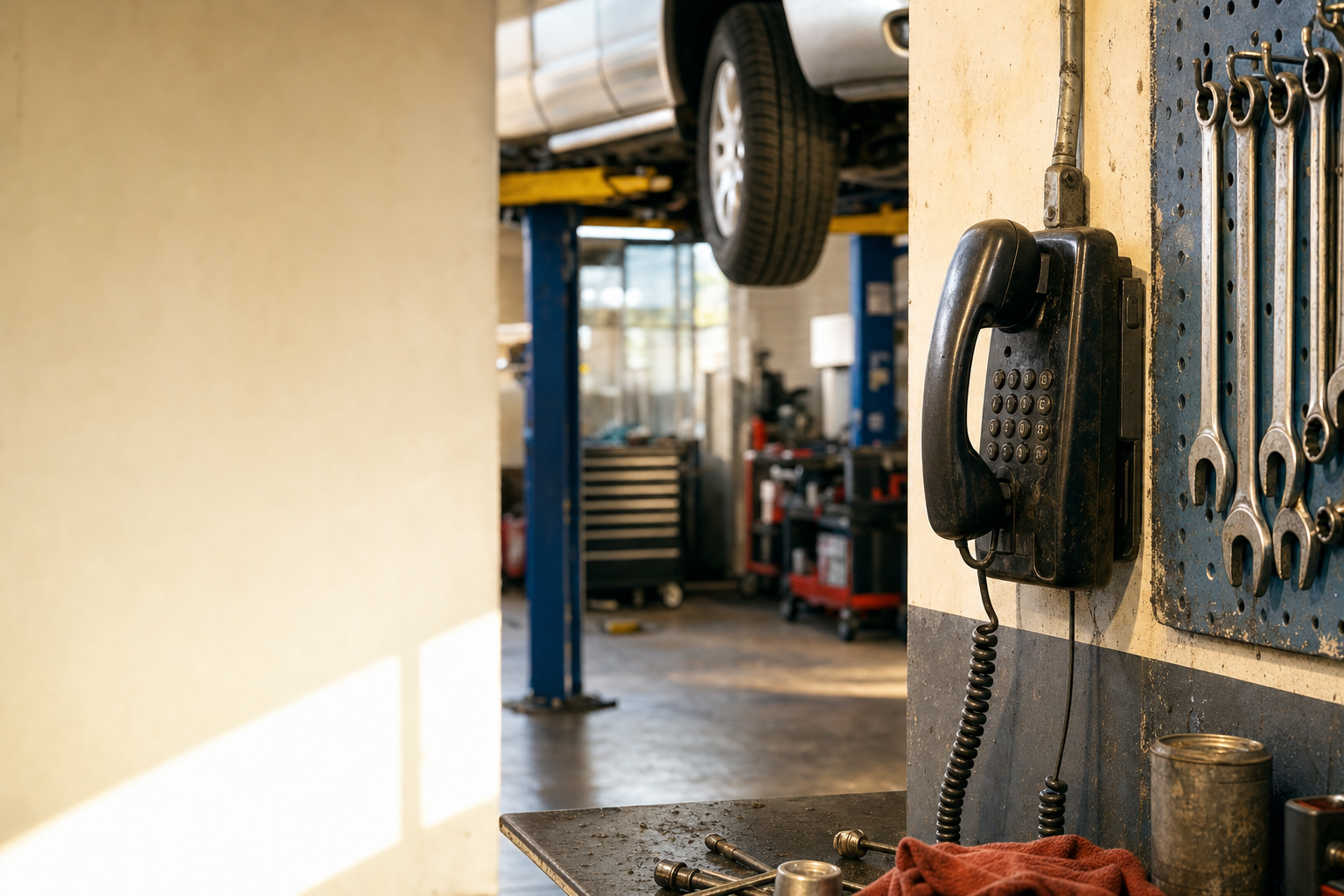
The phone rings when your hands are covered in grease
You are halfway through a timing chain swap. Your one service writer is checking in a vehicle. The phone rings. Nobody answers. The caller waits four rings, maybe five, then hangs up and calls the next shop on Google Maps.
That is not a hypothetical. That is Tuesday.
Most independent auto repair shops run lean. One to three techs, maybe a service writer who doubles as the parts runner, and the owner doing everything else. The phone is supposed to be covered, but in practice it gets covered when someone happens to be free, which is never at the exact moment a new customer calls.
The math on this is brutal and most shop owners have never actually run it.
What a missed call actually costs you
Shops on Tekmetric averaged a $585.91 repair order in 2023, and it varies a lot by market. Let's call it $450 to be conservative. Shops that install call tracking are often surprised by how many inbound calls go unanswered during business hours. If you are taking 40 calls a week and missing 10 of them, and even half of those callers were ready to book, that is 5 lost repair orders per week.
Five jobs at $450 is $2,250 a week. That is $117,000 a year walking out the door because nobody picked up the phone.
That number feels big because it is. But here is the thing: most of those callers do not leave a voicemail. They just disappear. You never even know they existed. The problem is invisible, which is exactly why it stays unsolved for years.
The three situations where calls get dropped
- Mid-morning rush (9 to 11 AM): Cars are being checked in, techs are asking questions, the phone rings constantly. Whoever is at the desk picks up when they can.
- Lunch window: Staff rotates out. If your service writer is eating, the phone goes to voicemail or rings out.
- After hours and Saturday afternoon: You close at 5:30. Customers with a car problem at 6 PM call anyway. They get nothing.
After-hours calls are the most underrated revenue leak in the shop business. A person whose check engine light came on during their commute home is motivated right now. If your voicemail picks up and the shop down the street has someone answering, you lose that customer before your next business day even starts.
Hiring another person is not the answer (at least not the first answer)
The instinct is to hire a receptionist. And sometimes that is the right call. But a full-time receptionist costs around $38,000 a year in median wages (Bureau of Labor Statistics) alone, before you add payroll taxes, benefits, and the reality that they still cannot answer the phone when they are with a customer, on break, or out sick.
A part-time phone person helps but creates coverage gaps. An answering service picks up the call but usually cannot tell a customer how much a brake job costs, when you have availability, or whether you work on European vehicles. They read from a script and promise a callback. Half the time the customer has already booked somewhere else by the time you call back.
What shops actually need is something that answers immediately, sounds like your shop, knows your services and rough pricing, and can capture the customer's information or book them directly. That used to not exist at a price that made sense for a small shop. It does now.
How an AI receptionist actually works for a repair shop
The version of AI phone answering that is worth your time is not a phone tree. It is not "press 1 for hours, press 2 for appointments." Those systems have existed for decades and customers hate them.
A real AI receptionist works like this: you paste your shop's website URL into a setup page, and within about 20 seconds the system reads your site, pulls your services, your hours, your location, your general pricing language, and your tone. Then it is ready to take calls. No account creation required upfront, no card, nothing installed on your end. You can literally talk to it yourself and hear how it handles "how much for a full synthetic oil change on a 2019 F-150" before you commit to anything.
When a customer calls your shop, the AI picks up immediately. It greets them by your shop name, answers questions about services and availability, handles the "do you work on Hondas" type questions, and either books the appointment directly into your calendar or captures the name and number and sends it to you as a lead. It does not put people on hold. It does not forget to call back. It works at 11 PM on a Saturday the same as it does at 9 AM on a Monday.
This is not magic. It is also not perfect. A customer who calls with a genuinely complex diagnostic question will get routed to you or a tech for follow-up. That is fine. The goal is not to replace your service writer. The goal is to make sure zero calls go unanswered and zero leads fall through the gap while your people are doing things that actually require a human.
Before and after: what this looks like in real numbers
| Situation | Before AI receptionist | After AI receptionist |
|---|---|---|
| Calls answered during business hours | Some go to voicemail | 100% |
| After-hours calls captured | Voicemail only | 100% |
| Average response to a missed call | Next business day, if noticed | Immediate, same call |
| Cost of coverage | Around $38,000/yr in wages (receptionist) or $300 to $600/mo (answering service) | Under $300/mo for most shops |
| Can answer "do you work on diesels" | Depends who picks up | Yes, trained on your site |
| Sick days, vacation gaps | Calls go unanswered | No change in coverage |
Step by step: how to set this up for your shop
- Check what your website actually says. The AI trains on your site. If your site does not list your services, your hours, or your service area, fix that first. A one-page site with accurate information will train better than a five-page site that is outdated.
- Try the AI before you commit to anything. Go to the setup page, drop in your URL, and actually call the number it gives you. Ask it the questions your customers ask. If it sounds right, move forward. If something is off, you will know immediately what to correct.
- Set your call routing rules. Decide which calls you want the AI to handle end-to-end (new appointment requests, hours questions, pricing questions) and which should ring through to a live person (customers with existing vehicles in the shop, anyone who says "my car is there right now").
- Forward your shop's main number. This takes about two minutes with your phone carrier. You do not need new hardware. The AI answers on the forwarded line and hands off or captures based on the rules you set.
- Review the first week of call logs. Every AI call gets logged. Read through the transcripts. You will find out what questions you did not know your customers were asking, which is genuinely useful for how you train your staff too.
- Adjust based on what you see. If the AI is stumbling on a specific question type (your warranty policy, for example), add that language to your website or directly into the AI's knowledge base. This is not a set-it-and-forget-it tool but the maintenance time is maybe 20 minutes a month once you are dialed in.
What about the customers who just want to talk to a real person?
This is the objection every shop owner raises, and it is a fair one. Some customers, especially older ones, want a human. A well-configured AI should offer to connect them to someone at a natural point in the conversation, especially if the customer signals frustration or asks for it directly.
Most callers do not mind talking to an AI as long as it answers quickly and actually has the information they need. What customers hate is being put on hold, being transferred three times, or leaving a voicemail and waiting 24 hours. An AI that picks up on the first ring and correctly answers "yes, we work on Toyota Tundras, we have availability Thursday at 10 AM" is a better experience than a human who puts them on hold for four minutes.
That said, if a customer specifically asks for a person, the system should route them. Non-negotiable. A customer who has to fight the phone system to get a human is a lost customer.
How this fits into the bigger picture for your shop
The phone is the front door of your business. Everything else you invest in, your auto repair marketing, your Google reviews, your location, drives traffic to that front door. If the door does not open reliably, the investment in everything upstream is wasted.
Shops that fix the phone problem first start to notice other gaps. Customers who booked an appointment do not get a reminder and do not show up. Jobs that are done sit uncollected because nobody called to say the car is ready. Customers who had a good experience never hear from the shop again. These are all problems that live inside your communication system, and they all compound each other.
That is why the phone coverage fix is usually step one, not the whole answer. Once that is solid, shops layer in automated appointment reminders, follow-up texts after service, and review requests. The shop CRM piece handles the customer relationship side once the initial call is captured. But none of that works if the phone does not get answered in the first place.
Start there. One problem, fix it completely, then move to the next one.
Frequently asked questions
Will the AI be able to give accurate prices, or will it just say "call for a quote"?
It depends on what your website says. If your site lists pricing ranges, the AI will use them. If your site says nothing about price, the AI will tell callers that pricing depends on the vehicle and offer to have someone follow up with a quote. The fix is simple: add a pricing page or at least a services page with typical ranges to your site. Most shops are vague about pricing online for competitive reasons, which is understandable, but "starting at" ranges are enough for the AI to give useful answers.
What happens if the AI makes a mistake and books someone for a service you do not offer?
This is why you review call logs in the first week. If the AI is booking customers for something you do not do, you either correct your website (which probably implied you do it) or you add a direct instruction to the AI's settings. Mistakes in the first week are common and fixable. Mistakes after a month usually mean the initial setup was not reviewed carefully enough.
My shop already has an answering service. Why would I switch?
Traditional answering services answer the phone but cannot answer your questions. They take a name and number and promise a callback. The AI answers the question right then, which is what the customer actually wants. Callbacks convert at a fraction of the rate of live answers because by the time you call back, the customer has often already booked somewhere else. If your answering service is capturing leads and converting them well, that is worth keeping. If you are paying for messages that rarely turn into jobs, that is worth looking at honestly.
Does this work for shops that are closed on weekends?
Yes, and it is arguably more valuable. A customer whose car breaks down Saturday afternoon calls you, hears it is closed, and moves on. With an AI answering, that same customer gets their question answered ("yes, we open Monday at 7:30 AM"), gets an appointment booked for Monday, and starts the week with the slot already filled. Closed days are some of the highest-leverage times to have the phone covered because your competitors are also closed and the customer is motivated right now.